
Bed bugs are among the most persistent and psychologically distressing household pests. Their ability to hide in tiny cracks, reproduce quickly, and feed discreetly at night makes them especially difficult to eliminate. One of the most common and important questions people ask when dealing with an infestation is: how long can bed bugs live without food? The answer is not as simple as a single number. Bed bug survival without feeding depends on multiple biological and environmental factors, and understanding these factors is critical for anyone trying to get rid of them effectively.
This article explores in detail how long bed bugs can survive without food, how their life stage affects their endurance, the role of temperature and humidity, and why starving them out is rarely a reliable control strategy. By the end, you will have a clear, science-based understanding of bed bug survival and what it means for real-world infestations.
Understanding Bed Bug Feeding Behavior
Bed bugs are obligate blood feeders, meaning they must consume blood to survive and reproduce. Unlike insects that can eat a variety of food sources, bed bugs rely exclusively on blood, most commonly human blood, although they can also feed on other warm-blooded animals when necessary. Their feeding behavior is highly specialized and adapted for stealth.
Typically, bed bugs feed every five to ten days under ideal conditions. A single blood meal can last anywhere from three to ten minutes, during which the bed bug becomes visibly engorged. After feeding, it retreats to a hiding place where it digests the meal, molts if it is immature, or produces eggs if it is an adult female.
Because bed bugs do not feed daily, they are naturally adapted to periods without food. This evolutionary advantage allows them to survive when hosts are temporarily absent, such as when people go on vacation or move out of an infested space.
Average Survival Time Without Food
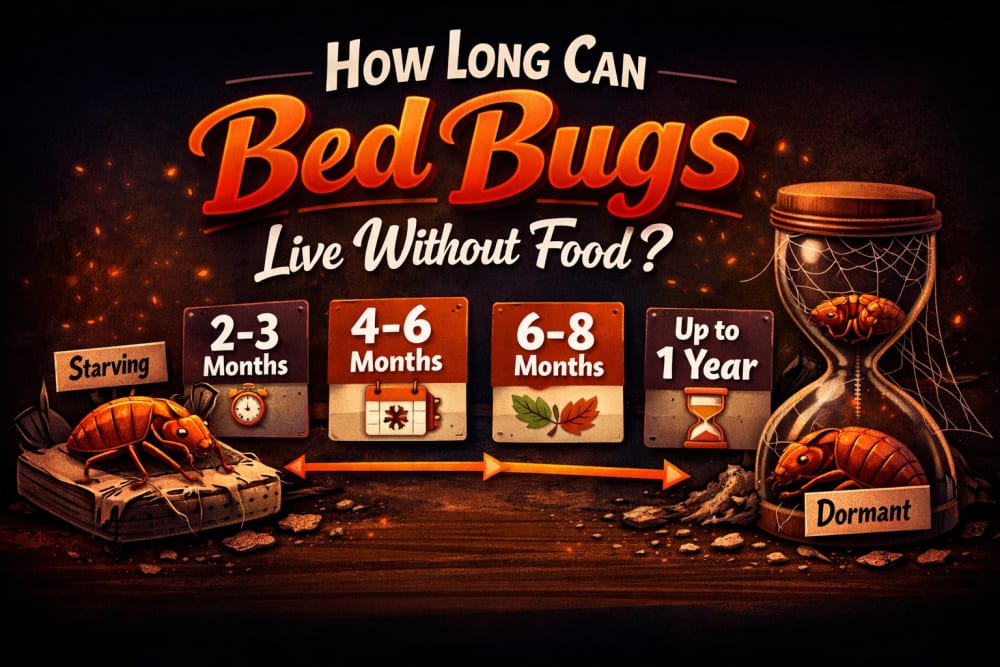
Under normal indoor conditions, adult bed bugs can live anywhere from two to six months without feeding. In some documented cases, adults have survived close to a full year without a blood meal. This remarkable endurance is one of the primary reasons bed bug infestations are so difficult to eliminate.
Immature bed bugs, known as nymphs, generally survive for shorter periods without food compared to adults. Depending on their developmental stage, nymphs may survive anywhere from a few weeks to several months without feeding. Early-stage nymphs are especially vulnerable because they require frequent blood meals to grow and molt.
It is important to note that these survival times are averages and estimates. Real-world survival can vary widely depending on environmental conditions and the overall health of the bed bug.
Differences Between Adult Bed Bugs and Nymphs
Bed bugs go through five nymphal stages before becoming adults. Each stage requires at least one blood meal to progress to the next. Because of this, nymphs are more dependent on regular feeding than adults.
Adult bed bugs have fully developed bodies and slower metabolisms, allowing them to conserve energy more efficiently. This makes them significantly more resilient during long periods without food. Adult females, in particular, can enter a semi-dormant state when hosts are unavailable, reducing activity and energy use.
Nymphs, on the other hand, have higher metabolic demands due to growth and molting. While older nymphs can survive longer than younger ones, they are generally less capable of enduring extended starvation. This difference plays a role in how infestations persist and re-emerge after treatment attempts.
How Temperature Affects Bed Bug Survival
Temperature is one of the most significant factors influencing how long bed bugs can live without food. In warmer environments, bed bugs are more active, their metabolism increases, and they burn through stored energy more quickly. As a result, they tend to die sooner when deprived of blood meals.
In cooler temperatures, bed bugs can survive much longer without feeding. Lower temperatures slow their metabolism, allowing them to conserve energy and extend their lifespan. This is why bed bugs in unheated buildings, storage units, or vacant apartments can survive for exceptionally long periods without feeding.
Research has shown that bed bugs kept at cooler temperatures can survive several months longer than those kept at typical room temperature. However, extreme cold can kill bed bugs, especially when temperatures drop below freezing for extended periods.
The Role of Humidity and Environmental Conditions
Humidity also plays a role in bed bug survival, although it is less influential than temperature. Bed bugs prefer moderate humidity levels similar to those found in human living spaces. Extremely dry conditions can lead to dehydration, which may shorten their survival time.
Access to hiding places further increases their chances of survival. Cracks, crevices, mattresses, furniture joints, and wall voids provide protection from environmental stressors and disturbances. In these sheltered environments, bed bugs are more likely to endure long periods without food.
Environmental stability, including limited exposure to light, vibration, and airflow, can also help bed bugs conserve energy. This explains why infestations can persist unnoticed for months, even when residents are rarely present.
Can Bed Bugs Enter a Dormant State?
Bed bugs do not truly hibernate, but they can enter a state of reduced activity often described as dormancy. During this period, their movement slows, feeding stops, and metabolic processes are minimized. This state allows them to survive longer without food.
Dormancy is more common in adult bed bugs and is typically triggered by the absence of hosts or unfavorable environmental conditions. While dormant, bed bugs remain hidden and are less likely to come into contact with pesticides or other control measures.
This ability to wait patiently for a host to return is one of the reasons infestations can reappear weeks or months after people believe the problem has been solved.
Why Starving Bed Bugs Rarely Works
Many people wonder if simply leaving an infested space vacant will eventually kill off bed bugs. Unfortunately, this approach is rarely effective. Because bed bugs can survive for months without feeding, short-term absences such as vacations or temporary moves do little to reduce an infestation.
Even extended vacancies may not guarantee elimination, especially if the environment is cool and undisturbed. When new occupants move in, dormant bed bugs can become active again and resume feeding.
Starvation also does not address eggs, which can remain viable for weeks before hatching. Once nymphs emerge, they will seek a blood meal as soon as a host is available, restarting the infestation cycle.
Implications for Bed Bug Control and Treatment
Understanding how long bed bugs can live without food is crucial for effective pest control. It highlights why thorough, multi-step treatment plans are necessary. Professional treatments often involve a combination of chemical applications, heat treatments, monitoring, and follow-up inspections.
Heat treatments are particularly effective because they kill bed bugs at all life stages, including eggs, in a single session. Chemical treatments, while useful, must be applied carefully and repeatedly to ensure that hidden and dormant bugs are exposed.
Encasements for mattresses and box springs can also help by trapping bed bugs and preventing feeding. However, these encasements must remain in place for many months to account for the insects’ ability to survive without food.
How Long Can Bed Bugs Live Without Food in Real-Life Scenarios
In real-world situations, bed bug survival without food often falls within a broad range rather than a fixed timeframe. In a warm, occupied home, bed bugs are likely to feed regularly and may not experience extended starvation. In contrast, in vacant apartments, hotel rooms, or storage facilities, bed bugs may go months without feeding and still survive.
Factors such as prior feeding history, age, and overall health also influence survival. A well-fed adult bed bug will live longer without food than one that has already been weakened by stress or partial treatment attempts.
This variability makes bed bugs unpredictable and underscores the importance of proactive prevention and professional intervention.
Common Myths About Bed Bug Starvation
One common myth is that bed bugs will die within a few days or weeks without feeding. In reality, their survival capabilities far exceed most people’s expectations. Another misconception is that bed bugs only live in beds and will disappear if the bed is removed. Bed bugs can hide throughout a room and remain dormant until a host returns.
Some people also believe that bed bugs cannot survive in clean environments. Cleanliness does not affect their ability to survive without food. Bed bugs are attracted to blood, not dirt, and can thrive in both spotless and cluttered spaces.
Final Thoughts on Bed Bug Survival Without Food
So, how long can bed bugs live without food? The answer ranges from several weeks for young nymphs to several months, and sometimes close to a year, for adults under favorable conditions. Their ability to slow their metabolism, hide effectively, and endure long periods without feeding makes them one of the most resilient household pests.
This resilience is precisely why bed bug infestations require comprehensive, informed approaches to control and prevention. Relying on starvation alone is rarely effective and often leads to prolonged frustration and recurring infestations.
By understanding the biology and survival strategies of bed bugs, homeowners, tenants, and property managers can make better decisions and take more effective action. Knowledge is one of the most powerful tools in the fight against bed bugs, and understanding how long they can live without food is a critical part of that knowledge.